

🟦Avatars & Character
An avatar represents the player's identity and is a means of interaction with your creative content. Avatars can impact storytelling, engagement, and logic in an Experience.
Avatars & Equipment
Game Client - change your avatar from your Inventory
Website - Change or buy an avatar
Own your look an change your strengths with Equipment NFTs
Modify your avatar's appearance
Modify your avatar's stats (e.g., power) or gain Abilities (e.g., flight)
The Experience creator may provide a custom avatar or equipment that you must use, but most Experiences will allow you to use any Avatar or Equipment NFTs purchased on the Marketplace.

Avatars represent a player's identity. Some equipment can modify the gameplay and the identity of the player.
Character
Character is defined by the narrative, or story, and sometimes by a custom avatar in Spawn Point behavior to support it.
Providing custom equipment in an Experience can be part of the storytelling, such as an astronaut suit for a space game. It's possible to set starter equipment in the Spawn Point, and there is a toggle to override player equipment so they must wear what is assigned to control avatar appearance and equipment benefits throughout the game.
Identity
What is an Avatar in The Sandbox?
A player's Avatar represents them during gameplay and can be changed between Experiences via The Sandbox dashboard.
How is an Avatar Made?
The voxel models, or VXM files, that are assembled to make Avatars are built in VoxEdit. Avatar collections in The Sandbox have traits like PFP (profile picture) NFTs that are combined in many variations.
Some collections are Sandbox Originals, and some are interoperable voxel avatars you automatically own if you purchase an NFT from a participating external PFP collection.
How to Get a Playable Avatar in The Sandbox
NFT Avatars Players Own Purchased from collections on the Marketplace that are offered by Partners and Game Maker Fund projects
Free Avatars Built with pre-made parts (some colour customisable) on The Sandbox website's Avatar page
Non-Player Characters (NPCs)
You can create a non-player charactor (NPC) of yourself and use it in Experiences as an easter egg. This is a very entertaining way to engage with your community.
Example:
The GMAE Game Jam encouraged creators to use 11 NPCs of well known members of The Sandbox staff and community. Experience submissions were filled with easter eggs, making them a blast to play and talk about.
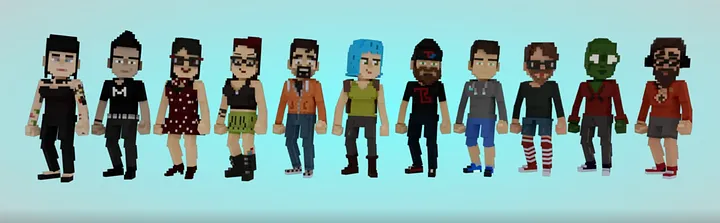
Example:
Download and modify Sebastien Borget's avatar and use it as an NPC in The Sandbox.
Using Your NPC "avatar" Externally
Though individuals can't create and activate what is technically an Avatar for use in any Experience in The Sandbox, you can create an animated 3D model to represent yourself and put it to many creative uses externally.
Exporting and Rendering
Pose your creation, modify lighting, and take a 2D screenshot with VoxEdit for a quick shot with a transparent background.
You can also export your 3D creation in many standard formats and render it with external software such as Light Tracer Render.
Social Media Identity
Use your unique design to represent yourself on social media, your videos, and your livestreams as you build your own brand and market your creative content.
Interoperability: Use in Other Software
Any software that allows you to import files in VoxEdit's standard export formats can bring your creations to life in other digital environments, such as other game engines, augmented reality software, and other 3D rendering and motion software. You can even make a high quality animated trailer starring your "avatar."
Avatars and the Game World
Integrate Player Avatars with Experience Logic
The Avatar tab in Global Parameters allows you to apply Tags to players' Avatars. By default, Avatar is added. You can use this tag as a target for any Behaviour or Component in the logic system for many types of interactions.
Examples:
Enemies detecting the Avatar as a target to attack
Healers following the Avatar to boost health if needed
Detecting an Avatar at a specific location and sending a Message which can trigger a short or long sequence of logic
Set a Custom Avatar

USE AS INTENDED IS HIGHLY RECOMMENDED
Custom avatar workarounds to simulate gameplay that is not built-in are not advised as they may conflict with and/or be made obsolete by software updates.
Examples:
Drive/mount
Throwing/projectile weapons
Aim assist
Build an Experience with Any Kind of Protagonist
A single player Experience can force a custom avatar for players to support a unique narrative. This can be a human, a creature, a spaceship, or anything else you can imagine.
Process
Create a custom avatar from a template or build it from scratch in VoxEdit.
Open the Experience in Game Maker, open the Global Parameters menu, and select the Avatar tab.
Open the Select Your Avatar dropdown and pick Custom Avatar.
In the popup window, select the entity, or asset, in your library that you want to assign every player of your Experience to use instead of their own.
Use the TAB key to switch to play mode to test it.
Custom Settings Unlocked!
Choosing a Custom Avatar allows for more granular control of the Avatar. Open the Behaviour tab within the Control tab in Global Parameters to modify previously locked controls. These settings allow you to change the game feel, such as the avatar's speed for various actions, jump force, attack damage, and interaction range.
Avatar Spawner
Set where the Avatar will spawn at the start of an Experience by moving the Avatar Spawner.
Customise the Avatar's Settings
Explore the Global Parameters documentation on customising logic related to the player under the Controller tab.
Example:
Setting a respawn tag is part of how to create a checkpoint system in Experiences.
Example:
Apply a specific amount of damage to the Avatar when it touches a certain type of block.
Last updated
Was this helpful?